Self-supervised MT
Bootstraps translation quality from monolingual corpora with minimal parallel supervision.
WAT 2025 Mumbai, India · ACL Anthology
Bootstrapping machine translation with language models that learn from their own cycles.
The bottleneck is not language.
Dedicated translation systems excel when bilingual corpora are abundant. For low-resource languages, those aligned sentence pairs are often scarce—or do not exist at all.
CycleDistill changes the starting point. A capable language model translates monolingual text, learns from the synthetic pairs it just created, then repeats the process. Each pass turns unlabeled language into a stronger translation system.
Bootstraps translation quality from monolingual corpora with minimal parallel supervision.
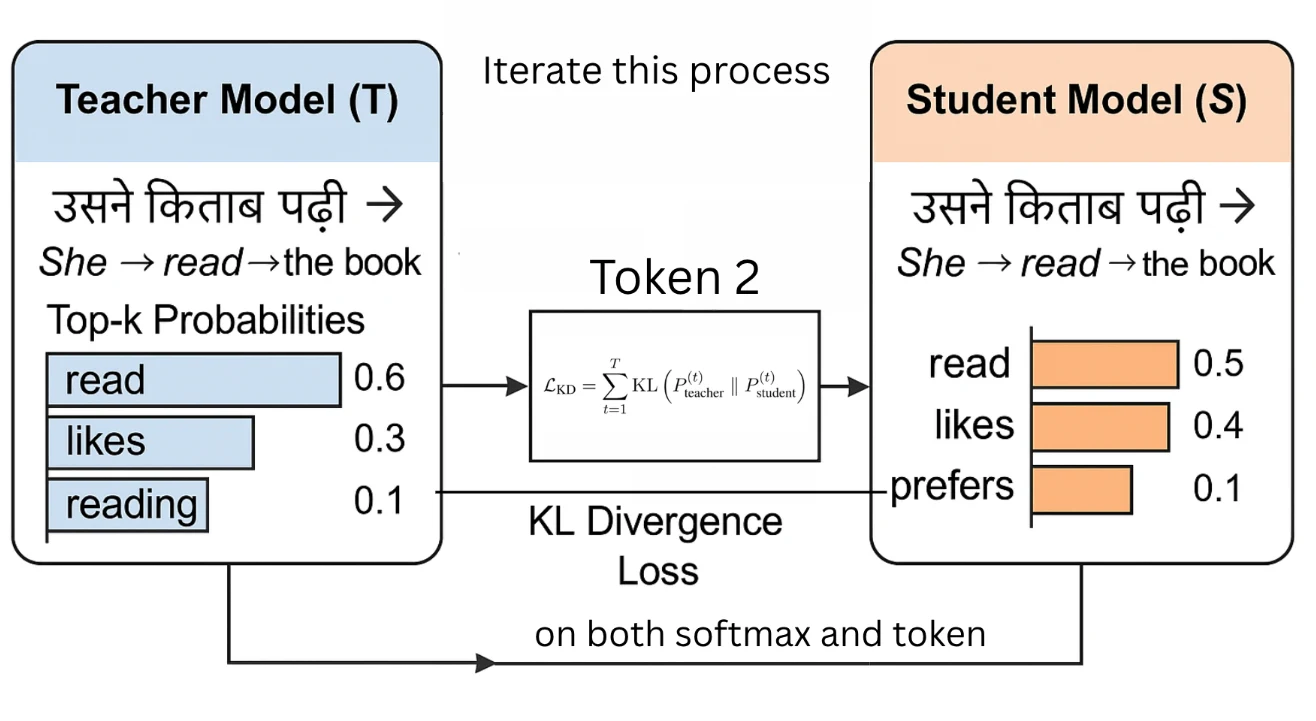
Preserves top-k token probabilities so the student learns more than the final decoded sequence.
Transfers translation ability from 9B→2B and 8B→3B models while improving student performance.
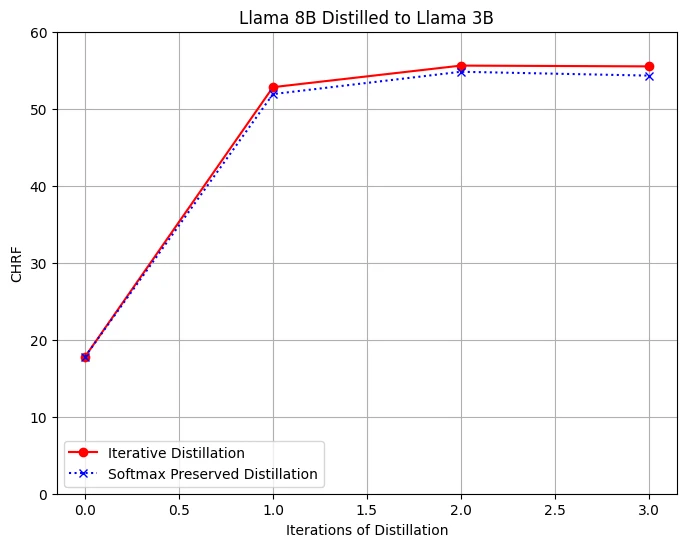
Three rounds are enough to expose the pattern: a large first jump, smaller gains after that, and a plateau by the third cycle.
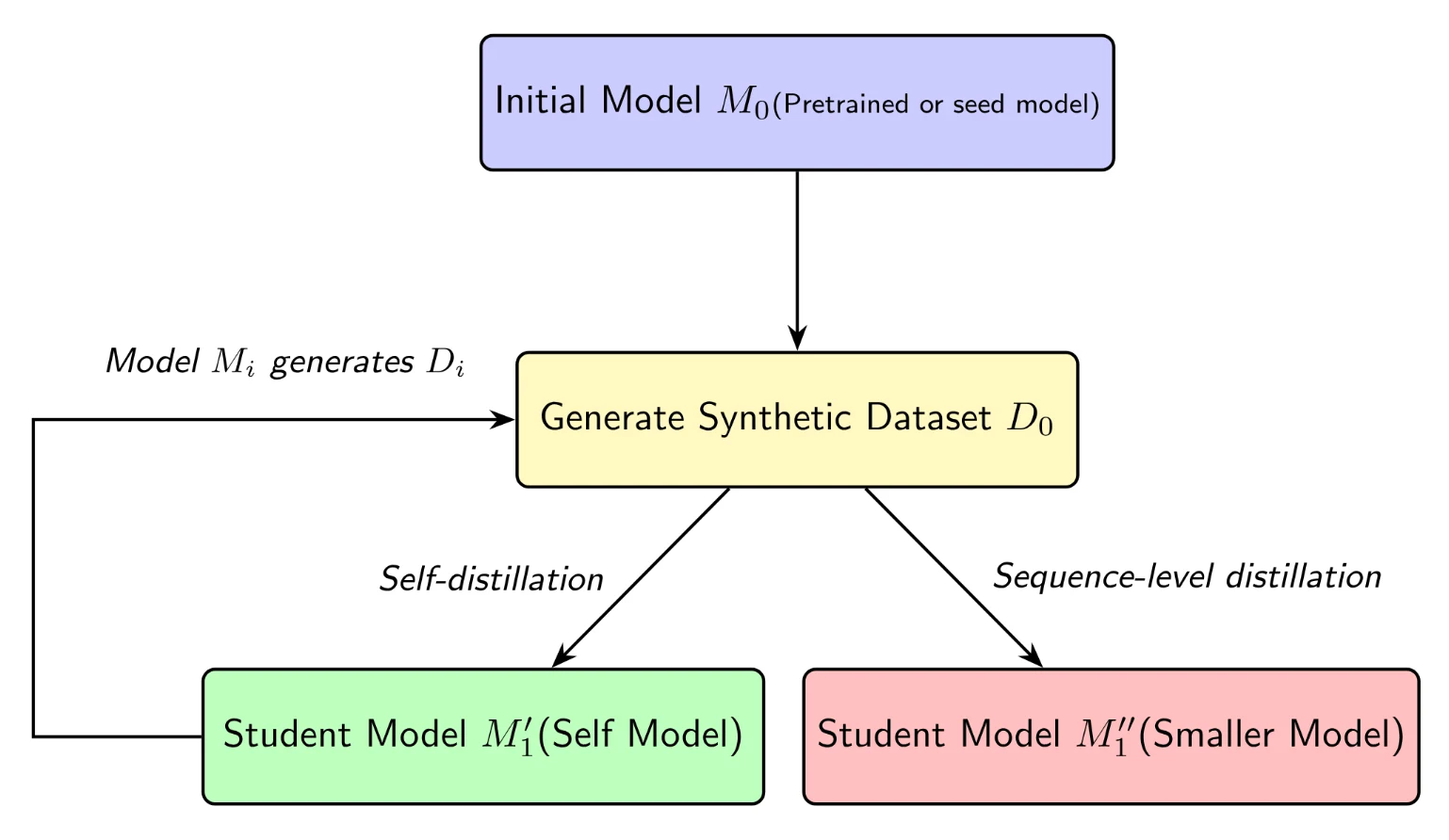
The current model translates 20,000 monolingual Indic sentences into English, creating a fresh parallel corpus for the next pass.
The synthetic pairs refine the same architecture and train a smaller student. CycleDistill studies both sequence-level targets and token-level probability distributions.
The newly distilled model becomes the next teacher. Its translations seed another dataset, closing the loop for up to three iterations.
Instead of retaining only the teacher’s chosen token, CycleDistill records the top 20 candidates and their probabilities. The student matches this richer probability landscape with KL divergence loss.
Compare zero-shot baseline chrF with the first iterative-distillation cycle across Bengali, Hindi, and Malayalam. Values below are taken directly from Table 1.
0-shot · iterative distillation (DD1) · IN22 Gen benchmark
One-shot prompting produced the best overall performance. Longer four-shot prompts diluted context, with sharper declines for morphologically rich Bengali and Malayalam.
LLaMA 3B’s average absorption rate was 1.190, versus 0.628 for Gemma 2B.
CycleDistill improved Nepali, but not Manipuri—if the base model cannot produce usable translations, the cycle has no reliable signal to amplify.
Performance often plateaus after cycle two; errors can compound when synthetic data is misaligned.
Selected figures from the WAT 2025 paper. Open the PDF for complete tables, analyses, and appendices.
Figures reproduced from Halder et al., WAT 2025. © Association for Computational Linguistics.
@inproceedings{halder-etal-2025-cycledistill,
  title     = {{CycleDistill}: Bootstrapping Machine
               Translation using {LLM}s with Cyclical Distillation},
  author    = {Halder, Deepon and Jayakumar, Thanmay
               and Dabre, Raj},
  booktitle = {Proceedings of the Twelfth Workshop
               on Asian Translation},
  month     = dec,
  year      = {2025},
  address   = {Mumbai, India},
  publisher = {Association for Computational Linguistics},
  pages     = {78--92},
  doi       = {10.18653/v1/2025.wat-1.7}
}